Gao, Ye, Yang, Zheng, Jang et al. (NVIDIA, 2026)
WoRV / MaumAI
World Action Models (WAMs):
Key Paradigm
WAMs generate “how to move” by predicting “what happens next” — inverse dynamics emerge from video understanding.
DreamZero (WAM = Policy):
DreamDojo (World Model):
The Shift
Same team, complementary paradigms: DreamZero is a policy, DreamDojo is a simulator.
The fundamental bottleneck:
The Core Problem
Robot world models plateau at observed setups and are unresponsive to counterfactual actions — actions the robot never performed in training (e.g., patting a toy, reaching and missing). Scaling teleoperation alone cannot cover the long tail.
Despite the embodiment gap, the underlying physics during interactions is largely consistent between humans and robots, enabling effective knowledge transfer.
— Gao et al. (2026)
Key idea: Human videos capture the same physics — contact, gravity, deformation, tool use — just with different end-effectors.
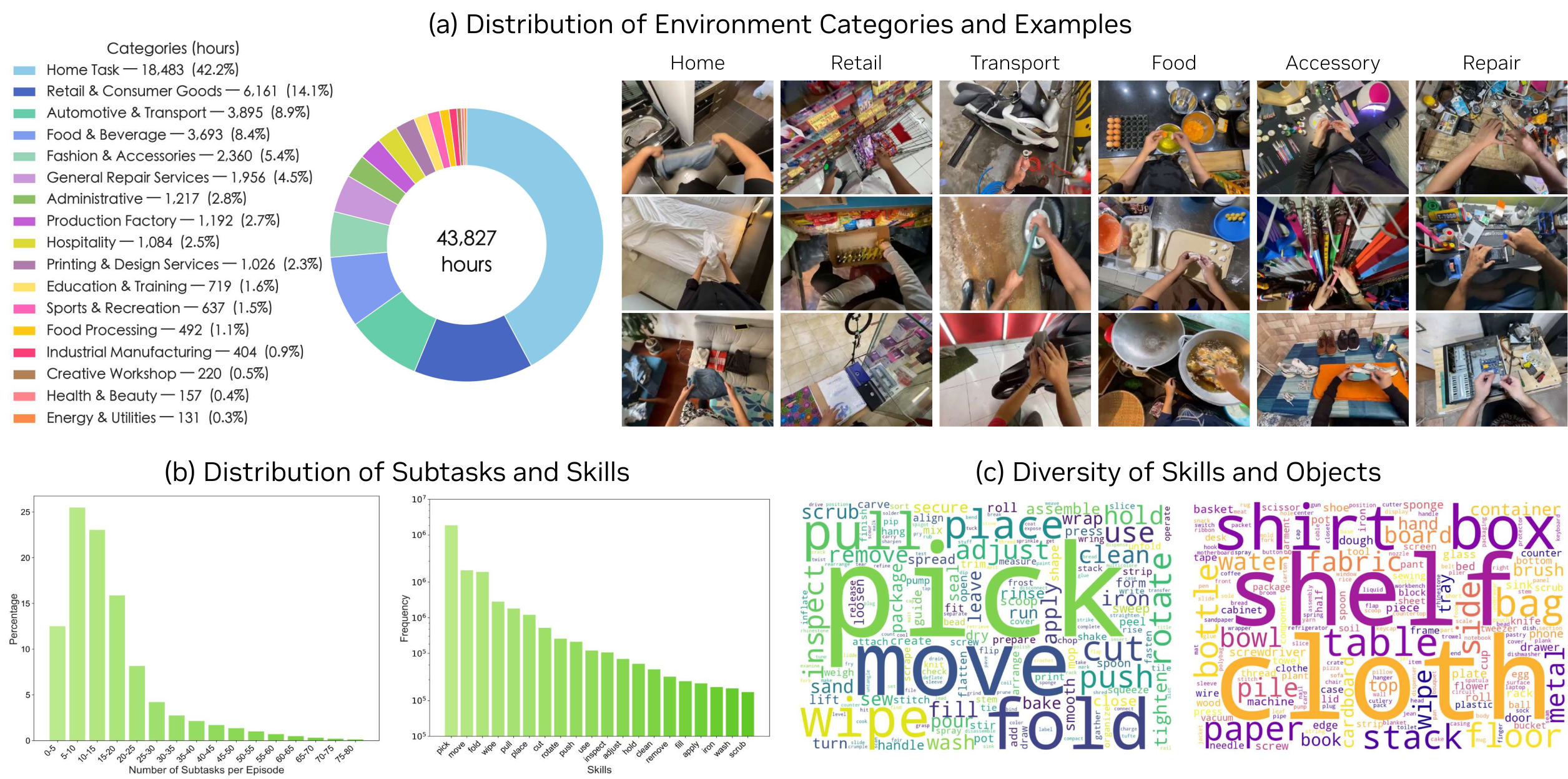
Dataset Scale
vs. prior largest (AgiBot World): 15x duration, 96x skills, 2,000x scenes
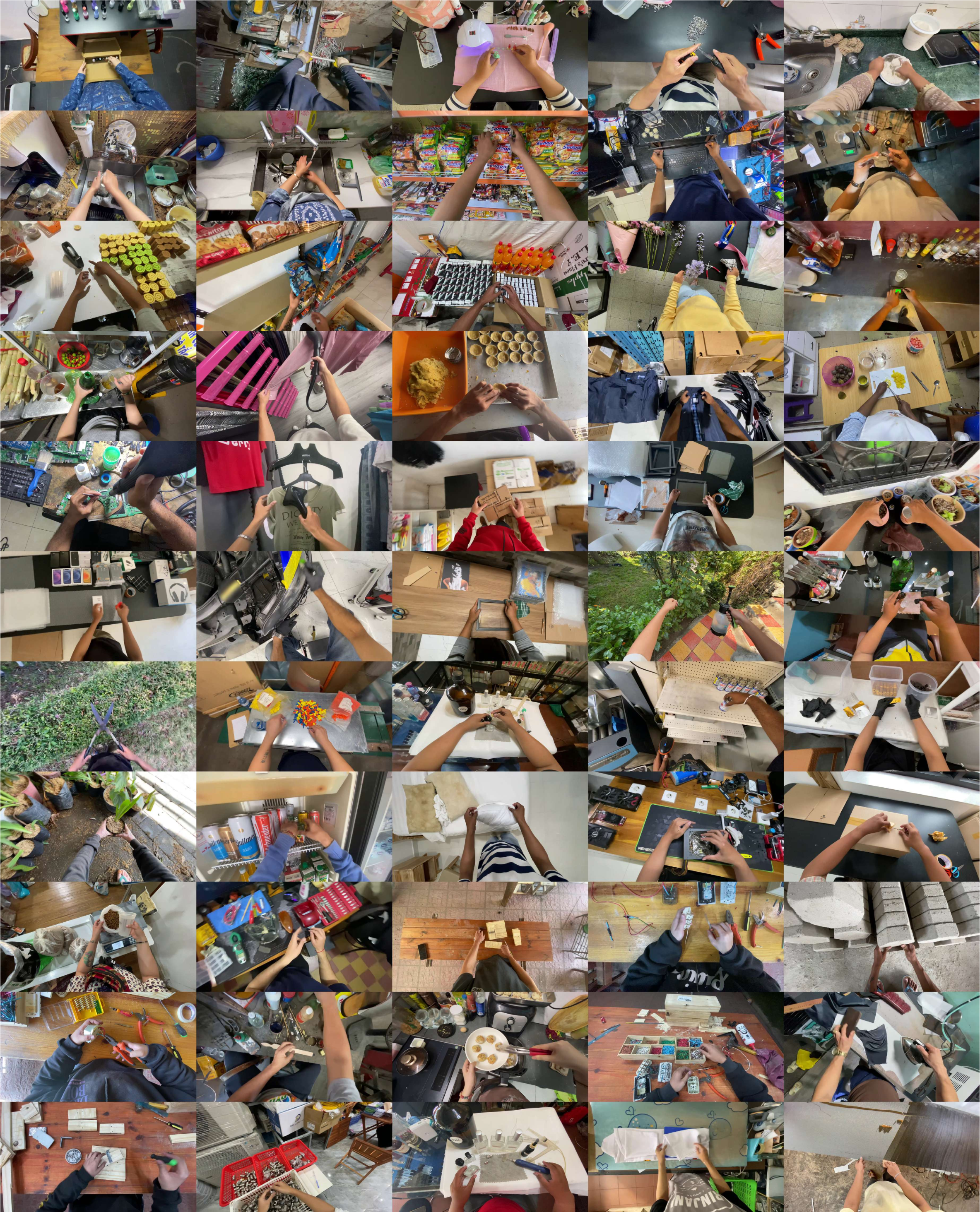
Data Mixture
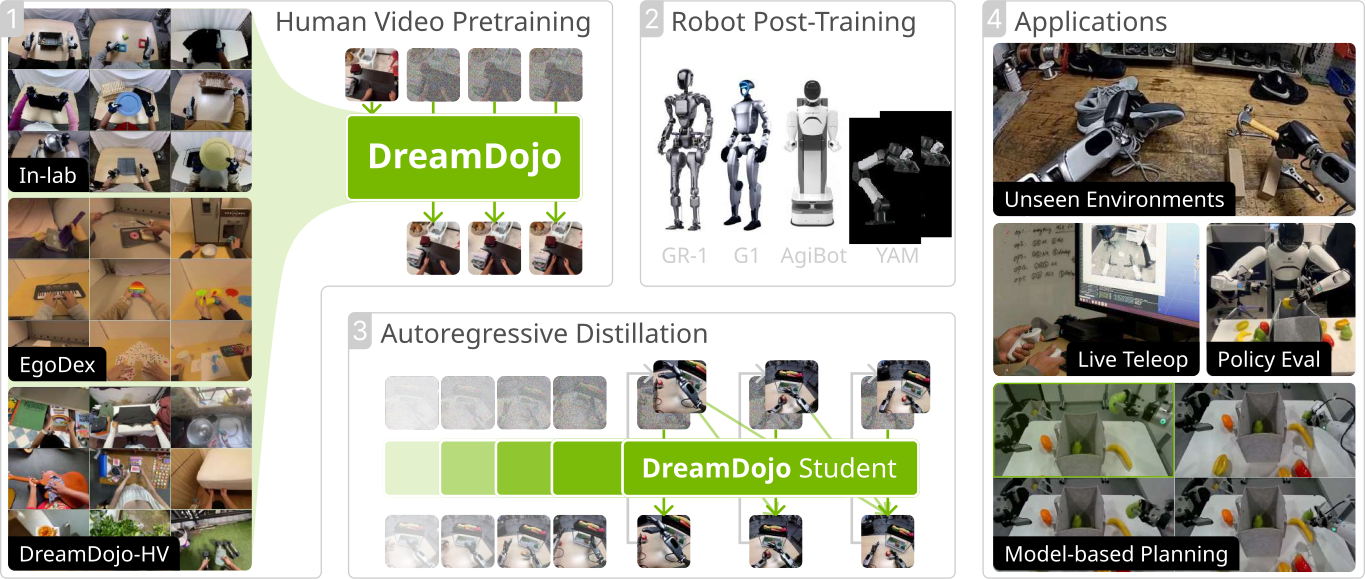
In-lab (55h)
Manus gloves, 35 skills, 1 scene
EgoDex (829h)
Apple Vision Pro, 194 skills, 5 scenes
HV (43.8Kh)
Crowdsourced, 6,015 skills, 1.1M scenes
Sampling ratio: In-lab : EgoDex : HV = 1 : 2 : 10
EgoDex sample
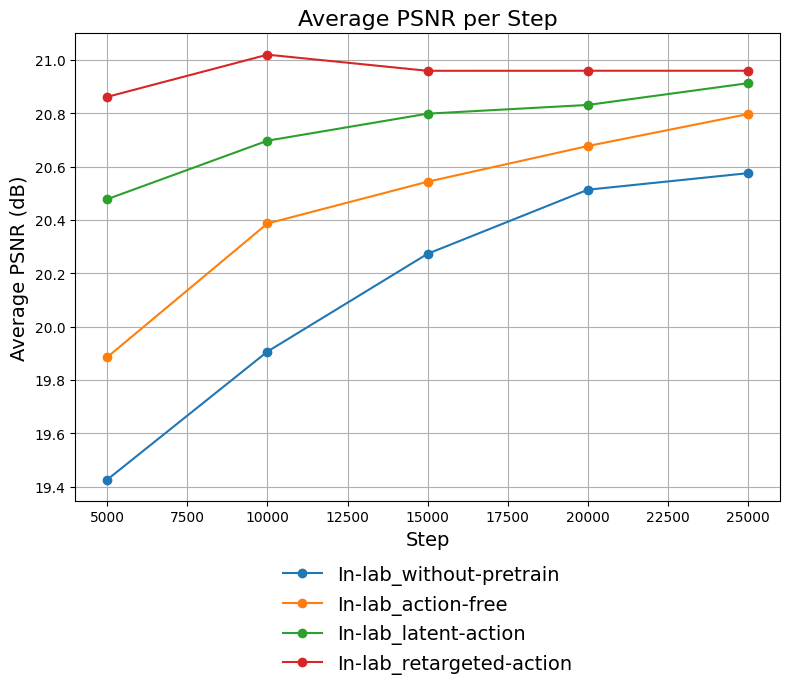
In-lab PSNR curves
Phase 1: Pretrain on human videos with latent actions
Phase 2: Post-train on target robot data (reset action layer)
Phase 3: Distill to autoregressive real-time student
Latent Action Model
Human videos are vast but lack action labels.
The Dilemma
Actionless pretraining wastes interaction knowledge. Ground-truth actions require expensive capture devices. We need a self-supervised middle ground.
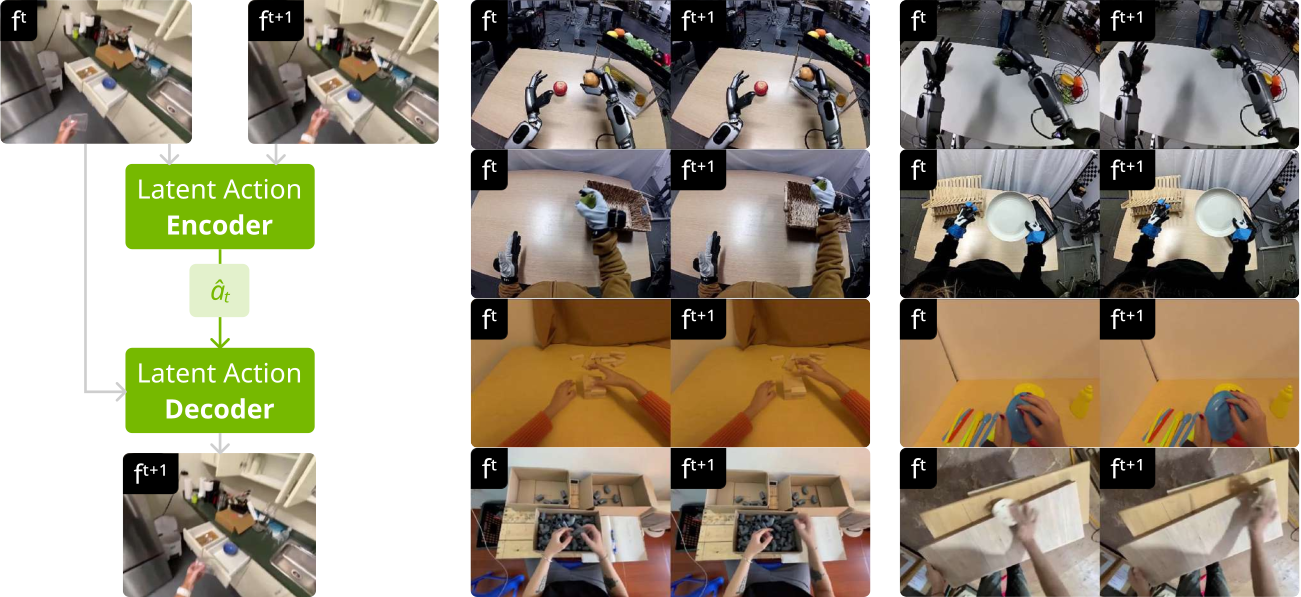
VAE with information bottleneck:
\mathcal{L}^{pred}_{\theta,\phi}(f^{t+1}) = \mathbb{E}_{q_{\phi}(\hat{a}|f^{t:t+1})} \log p_{\theta}(f^{t+1}|\hat{a},f^{t}) - \beta\,D_{KL}(q_{\phi}(\hat{a}|f^{t:t+1})||p(\hat{a}))
\hat{a} \in \mathbb{R}^{32}, \beta=10^{-6} (tight bottleneck \rightarrow forces action disentanglement)
Cross-Embodiment Transfer
The same latent action \hat{a} captures the same physical interaction regardless of whether it is performed by a human hand, a gripper, or a dexterous robot.
LAM Architecture (700M params):
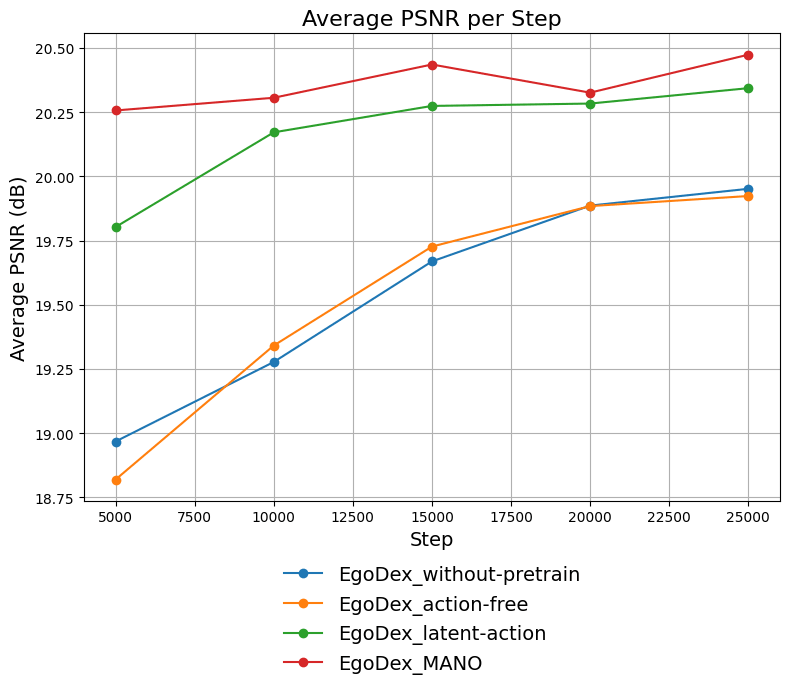
| Method | PSNR | LPIPS | Note |
|---|---|---|---|
| w/o pretrain | 20.576 | 0.222 | No human data |
| Action-free | 20.797 | 0.222 | Passive video |
| Latent action | 20.913 | 0.219 | Self-supervised |
| Retargeted GT | 20.960 | 0.219 | Requires gloves |
Key Finding
Latent actions achieve near-parity with ground-truth action labels — without any capture devices. The gap: <0.05 PSNR, 0.000 LPIPS.
My Take: This is the enabler for 44K-hour scale. You cannot put Manus gloves on a million crowdworkers, but you can run a VAE on their videos.
Architecture & Training
Foundation
Training setup:
Intuition
Learn a velocity field that transports noise \rightarrow data along straight paths. Simpler and faster than standard diffusion.
Flow matching loss:
\mathcal{L}_{\text{flow}}(\theta) = \mathbb{E}_{\mathbf{x},\epsilon,\mathbf{c},t} \left\|\mathbf{u}(\mathbf{x}_{t},t,\mathbf{c};\theta) - \mathbf{v}_{t}\right\|^2
where \mathbf{v}_t = \epsilon - \mathbf{x} (velocity = noise - clean data)
Design Choices
Action injection pathway:
\text{actions} \xrightarrow{\text{MLP}} \text{action embedding} \xrightarrow{+} \text{timestep embedding} \xrightarrow{\text{AdaLN}} \text{DiT blocks}
Scale, shift, and gate modulations in every DiT block
Key implementation details:
Implementation Pattern
My Take: The dual-path action injection is more sophisticated than the paper describes — actions modulate DiT through both timestep AND AdaLN scale/shift/gate pathways. The zero-init trick from ControlNet is crucial for preserving pretrained physics.
Problem: Flow matching supervises frames individually, ignoring temporal correlations.
Temporal consistency loss:
\mathcal{L}_{\text{temporal}}(\theta) = \mathbb{E}\Big[\sum^{K-1}_{i=1} \left\|(z^{i+1}-z^{i})-(v^{i+1}-v^{i})\right\|^2\Big]
Final objective:
\mathcal{L}_{\text{final}} = \mathcal{L}_{\text{flow}} + \lambda\,\mathcal{L}_{\text{temporal}}, \quad \lambda = 0.1
Post-Training Recipe
Embodiments: GR-1, G1, AgiBot, YAM — each post-trained separately. CFG disabled (no benefit).
Distillation Pipeline
Why distill?
Two Conversions Required
Student initialized from teacher weights, with bidirectional attention replaced by causal attention over a sliding window of 12 frames.
Stage 1: Warmup — student regresses to teacher ODE solutions
\mathcal{L}_{\text{warmup}} = \mathbb{E}_{x,t}\|G_{\text{student}}(x_{t},t)-x_{0}\|^2
Student generates via teacher forcing (clean context)
How it works:
Stage 2: Distillation — student trains on its own outputs (Huang et al. 2025)
\nabla\mathcal{L}_{\text{distill}} = -\mathbb{E}_{z,t}\Big[ (s_{\text{real}}(x_{t},t) - s_{\text{fake}}(x_{t},t)) \frac{dG_{\text{student}}}{d\theta}\Big]
KL divergence between teacher and student distributions (Yin et al. 2024)
s_{\text{real}}: score from real (teacher-generated) data | s_{\text{fake}}: score from fake (student-generated) data
Extended rollout: Student generates N'>N frames, loss on last N — reduces long-horizon drift.
Speed vs. Quality
| PSNR | SSIM | LPIPS | FPS | Pred | Ctx | |
|---|---|---|---|---|---|---|
| Teacher | 14.09 | 0.442 | 0.412 | 2.72 | 12 | 1 |
| Student | 13.15 | 0.379 | 0.485 | ~10 | 4 | 12 |
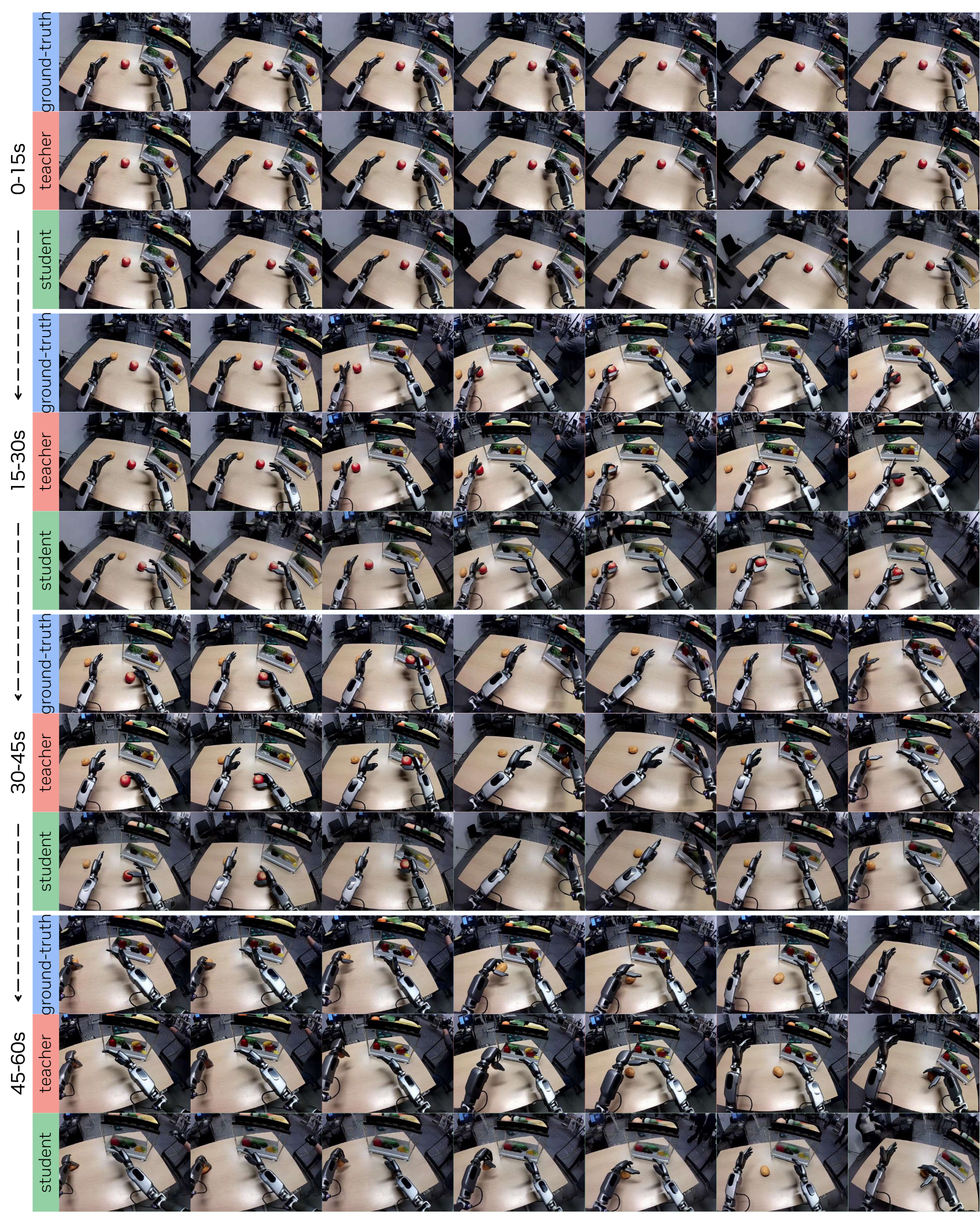
1-minute rollouts
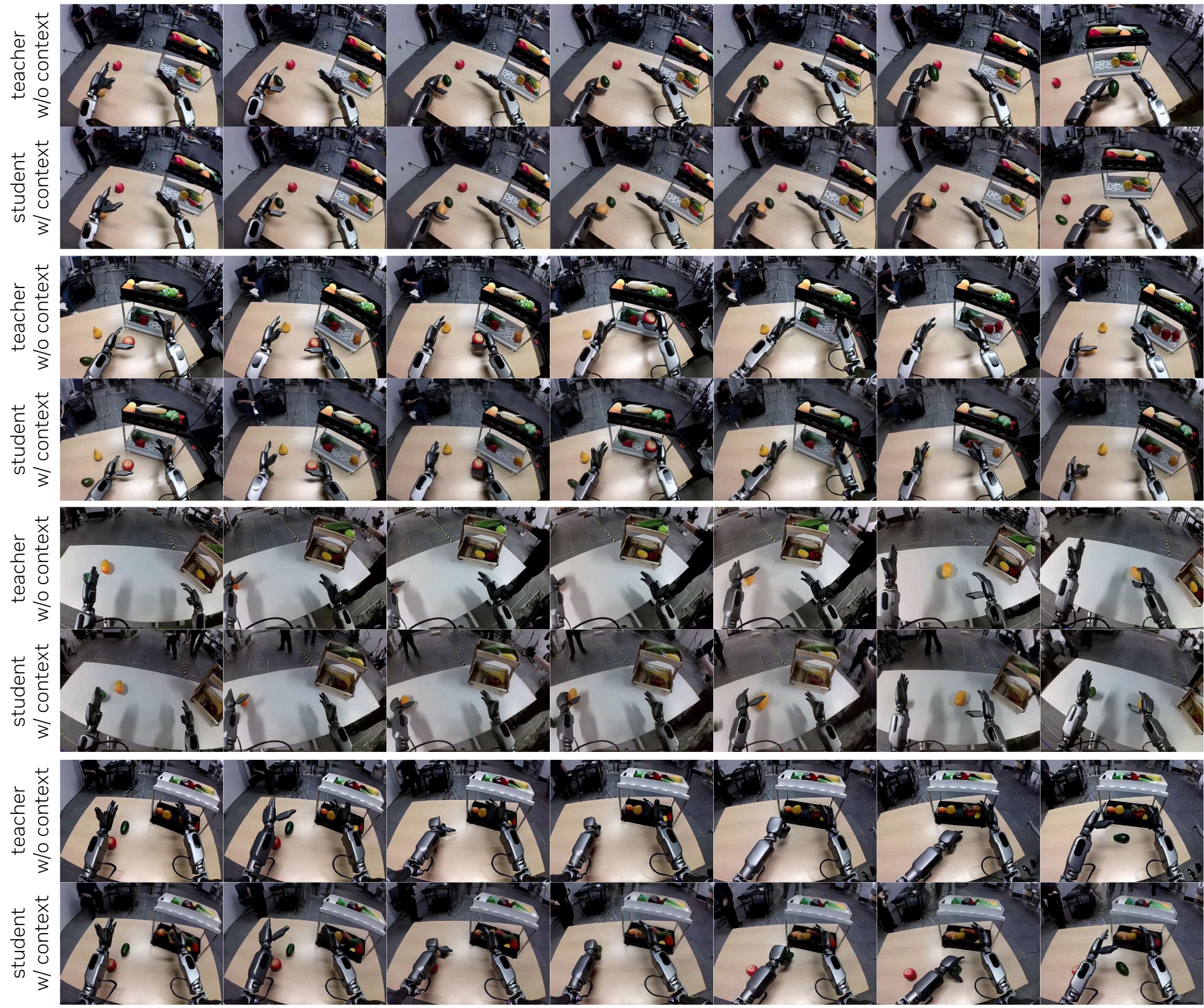
Context advantage
Experimental Results
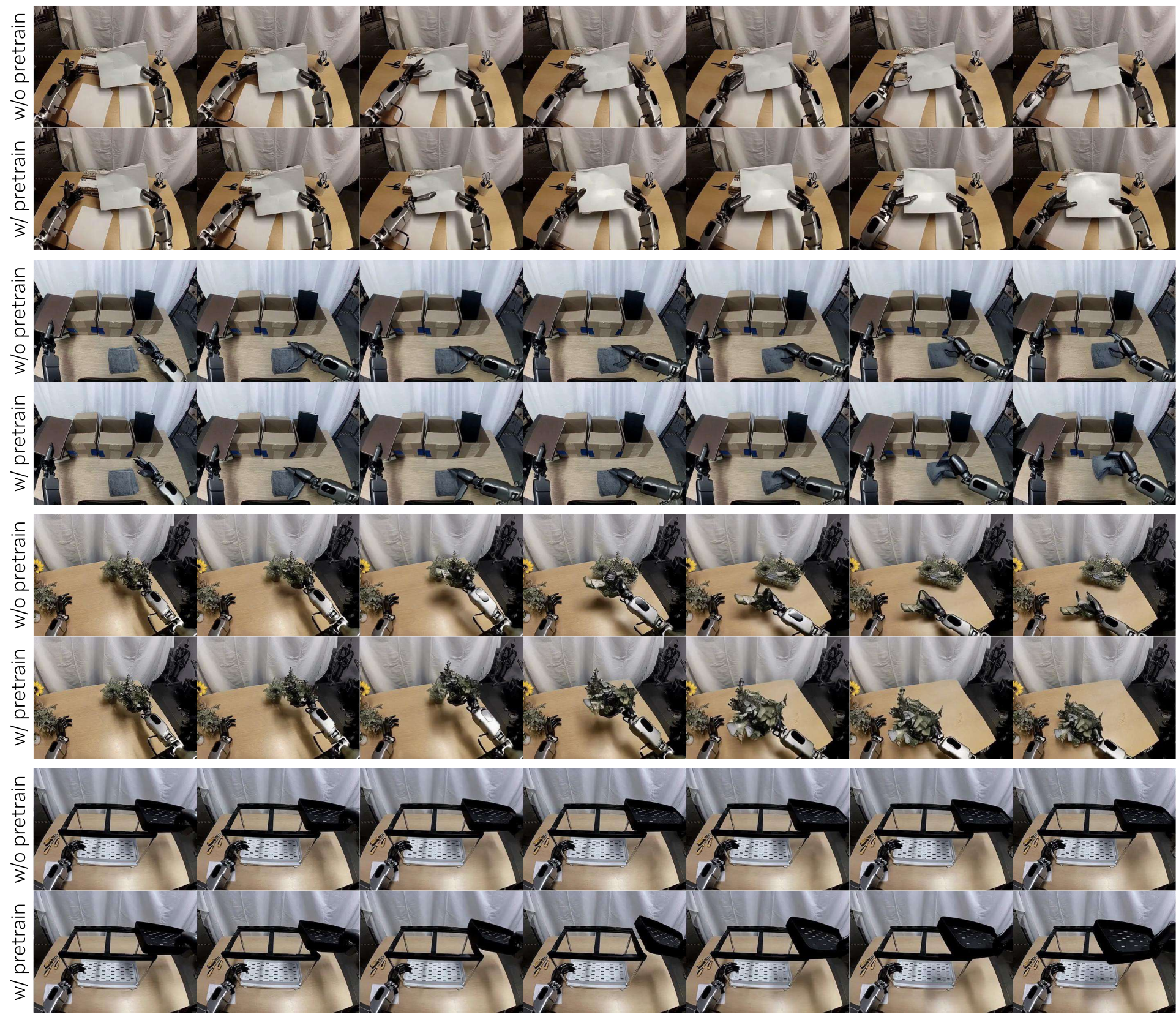
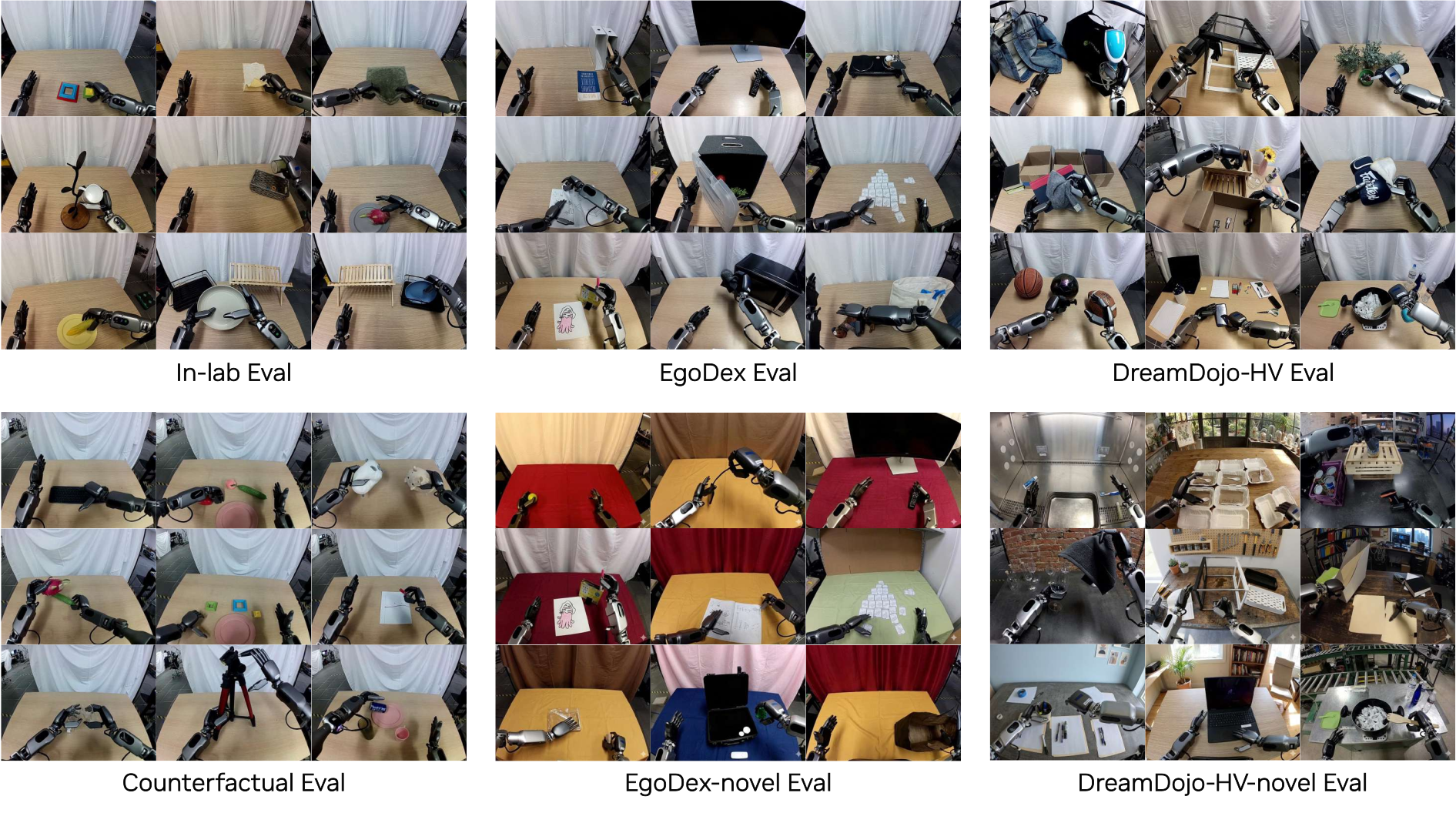
6 Evaluation Sets on GR-1
1. In-lab Eval 2. EgoDex Eval 3. HV Eval 4. Counterfactual Eval
5. EgoDex-novel (Gemini-edited BG) 6. HV-novel (Gemini-edited BG)
Metrics: PSNR, SSIM, LPIPS (auto); human preference for novel scenes.
| Data Mixture | In-lab | EgoDex | HV |
|---|---|---|---|
| No pretrain (Cosmos) | 20.58 | 19.95 | 18.27 |
| In-lab only | 20.91 | 20.27 | 18.62 |
| + EgoDex | 20.97 | 20.33 | 18.71 |
| + DreamDojo-HV | 21.02 | 20.41 | 18.72 |
| DreamDojo-2B | 21.11 | 20.41 | 18.81 |
| DreamDojo-14B | 21.41 | 20.53 | 18.92 |
Monotonic Improvement
Adding more human data consistently improves all OOD benchmarks — both physics modeling and counterfactual action following.
Human Evaluation (12 volunteers)
| Comparison | Physics | Action |
|---|---|---|
| DreamDojo-2B > Cosmos | 62.5% | 63.5% |
| DreamDojo-14B > Cosmos | 73.5% | 72.6% |
| DreamDojo-14B > DreamDojo-2B | 72.5% | 65.5% |
Two axes evaluated:
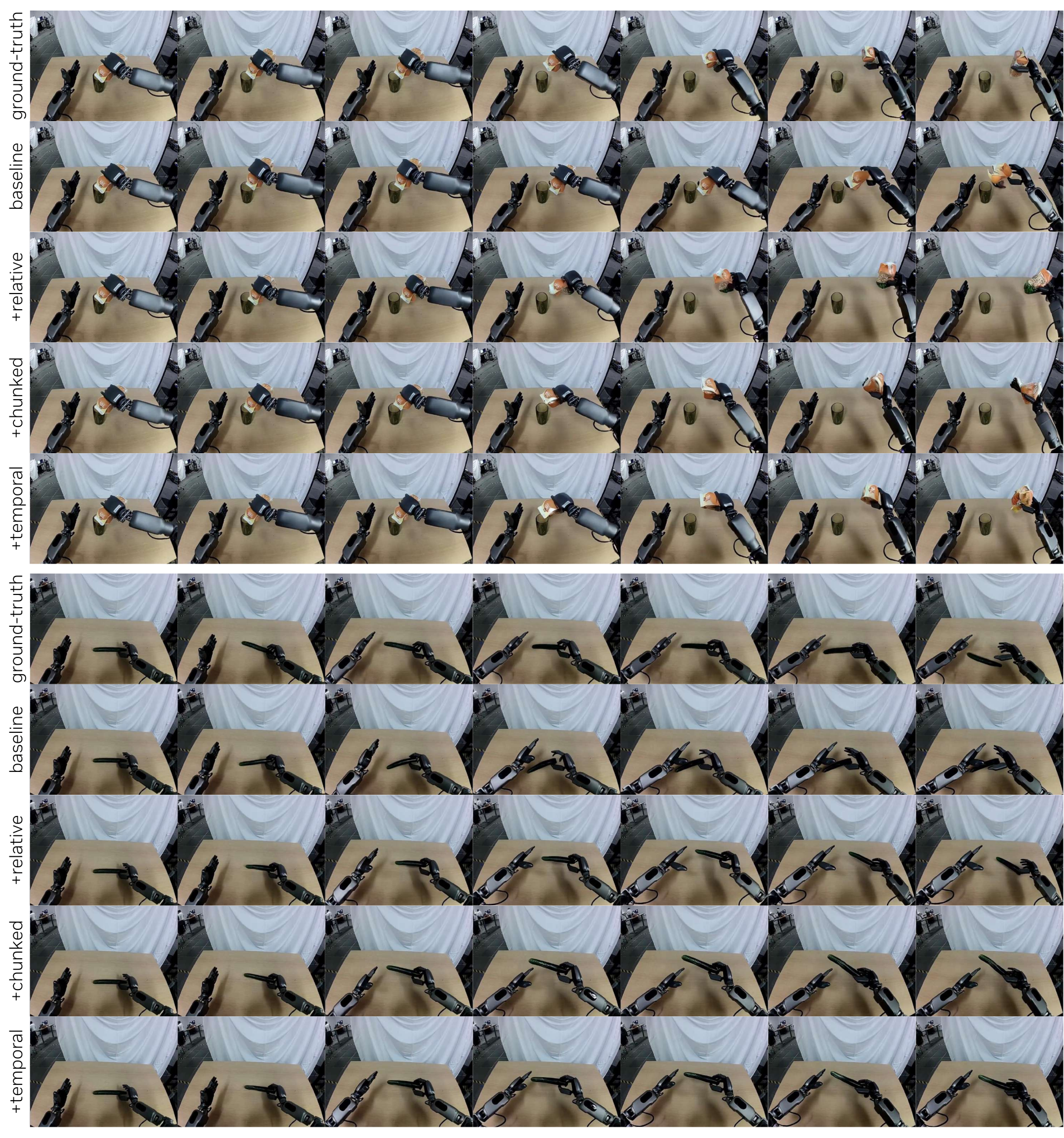
Counterfactual Eval metrics:
| Rel. | Chunk | Temp. | PSNR | SSIM | LPIPS |
|---|---|---|---|---|---|
| 19.45 | 0.768 | 0.211 | |||
| ✓ | 19.48 | 0.772 | 0.212 | ||
| ✓ | ✓ | 20.78 | 0.790 | 0.193 | |
| ✓ | ✓ | ✓ | 20.98 | 0.796 | 0.189 |
Takeaway
Chunked injection is the largest single gain (+1.30 PSNR). Relative actions alone have minimal effect, but temporal loss adds a further +0.20 improvement.
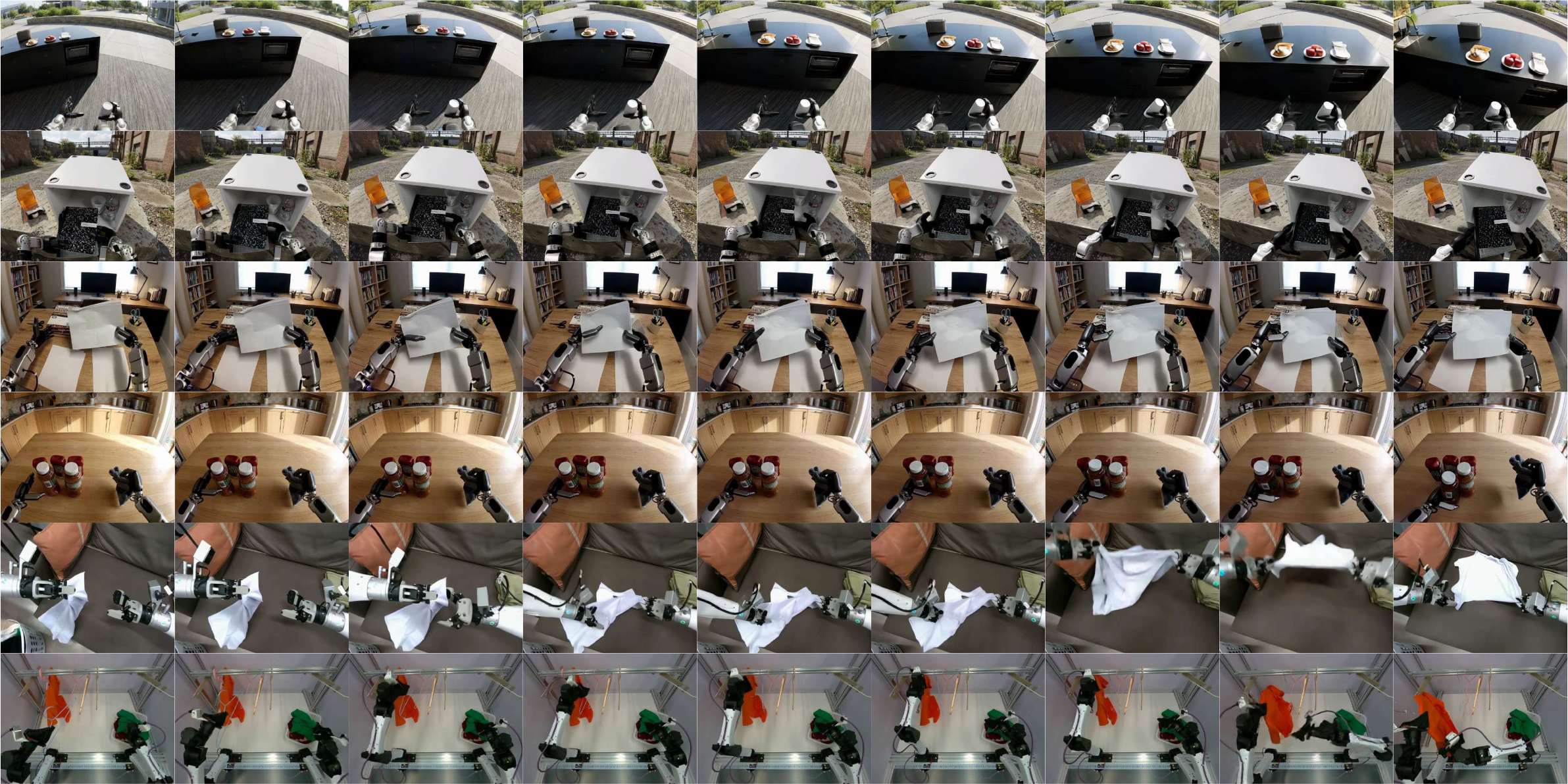
Four Robot Platforms
Post-trained on GR-1, G1, AgiBot, and YAM — each with separate post-training runs using the same pretrained foundation.
Per-embodiment adaptation:
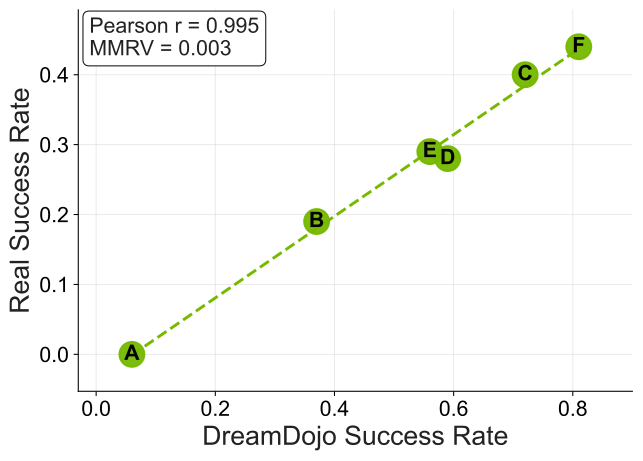
Correlation with Reality
Protocol:
DreamDojo can reliably rank policies without deploying on a real robot.
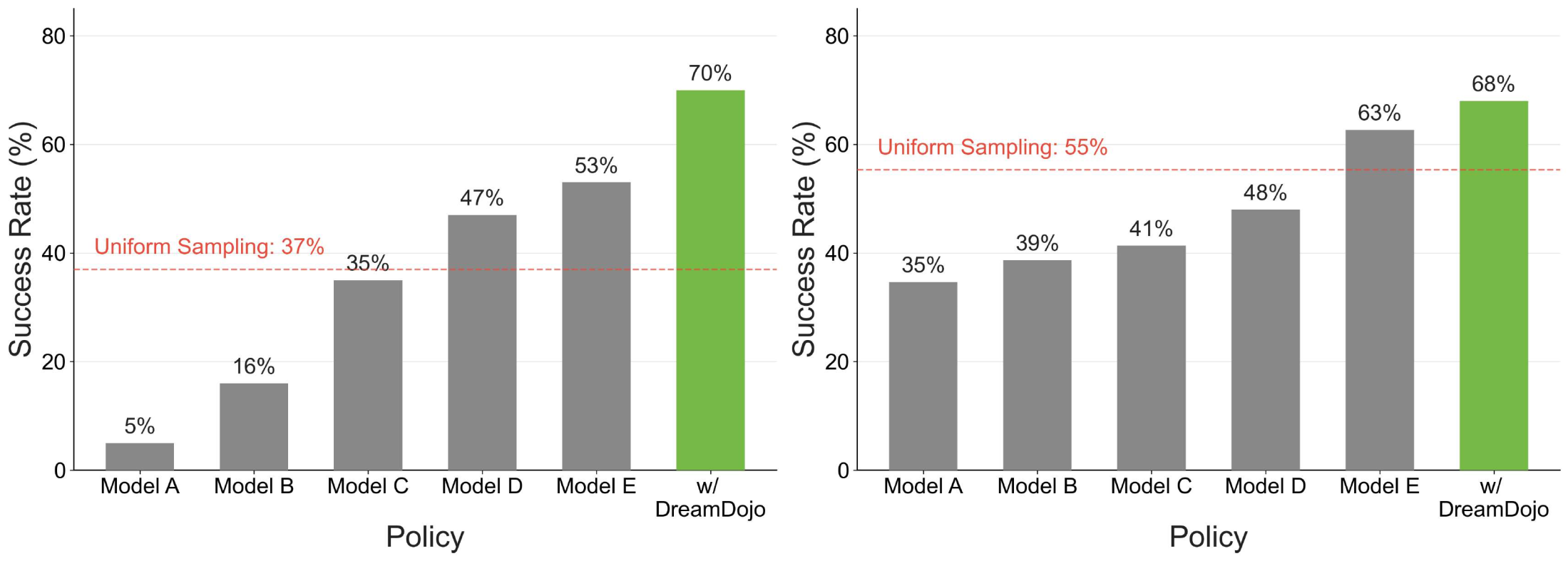
Model-Based Planning:
Live Teleoperation:
World models as simulators unlock planning, evaluation, and teleoperation — all from a single foundation.
Code-Level Insights
Production-Grade NVIDIA Code
DreamDojo’s codebase reveals engineering decisions the paper glosses over — these details matter for reproducibility and understanding.
What we can learn:
Implementation Details (Not in Paper)
LatentActionModel wraps asymmetric encoder–decoderSpatioTemporalTransformer (joint space-time attention across frames)SpatioTransformer (spatial-only — no temporal mixing)nn.Parameter(torch.empty(1, 1, 1, patch_token_dim))Key asymmetry: The encoder sees both frames jointly (spatiotemporal), while the decoder reconstructs from action + single frame (spatial only). This forces all temporal information through the 32-dim bottleneck.
Concrete Code Patterns
rearrange(action, "b 1 (t d) -> b t d", t=...)action_embedder_B_D (global timestep path) vs action_embedder_B_3D (per-frame spatial path)My Take: Two separate action MLPs — not one — feed into different pathways. This dual-path design is more sophisticated than the paper describes and explains why chunked injection has such a large ablation effect.
Three Distinct Loaders
Dual-resolution processing: LAM operates at 320x240 (efficiency), while the world model trains at 640x480 (quality). Separate tokenizer passes for each resolution.
SE(3) Math for Relative Actions
My Take: The relative action computation uses proper SE(3) math — translation deltas in body frame, not naive subtraction. The 20x scaling factor is a practical detail the paper omits entirely. These “boring” engineering choices are what make the model actually work.
Discussion & Takeaways
Paper-Acknowledged Limitations
My Take: The proprietary 43.8K-hour dataset is both the biggest strength and weakness — it makes the results hard to reproduce. The eval overestimation suggests the model struggles with nuanced failure modes.
DreamZero (WAM = Policy):
DreamDojo (World Model):
Complementary, Not Competing
DreamZero asks “what action produces this future?”
DreamDojo asks “what future does this action produce?”
| DreamZero | DreamDojo | |
|---|---|---|
| Dynamics | Inverse (IDM) | Forward (WM) |
| Backbone | WAN 2.1 | Cosmos-Predict2.5 |
| Tokenizer | WAN 2.1 (4\times) | WAN 2.2 (4\times) |
| Conditioning | Joint video+action | Action \rightarrow video |
| Data | Robot only | Human + robot |
| Scale | 500h robot | 44.7Kh total |
| Latent actions | No | Yes (32-dim VAE) |
| Distillation | Flash (1-step) | Self Forcing (4-step) |
| Speed | 7Hz (2xGB200) | ~10 FPS (1xH100) |
My Take: The Cosmos-Predict2.5 backbone gives DreamDojo stronger video priors, while the latent action framework enables human video pretraining at scale. Different tools for different jobs.
DreamDojo is part of a rapid convergence in world models for robotics:
The trend: Scale up human video, bridge the embodiment gap with latent actions, distill for real-time interaction.
The future of robot world models is human-video-native.
Paper & Code:
github.com/NVIDIA/DreamDojoDreamZero (predecessor):
dreamzero0.github.ioKey References:
Q&A