Who Am I?
10+ top-tier papers
1,850+ citations
double-digit h-index
STEM Career Sprint 2026
From papers to products
Don't get swept away by the AI wave —
become the surfer.
Speaker
Yunsung Lee
WoRV @ Maum.ai
Venue
SUNY Korea
April 4, 2026

Opening roadmap
The AI shift is already changing how people build, learn, and get hired. Today is about how to ride it on purpose.
Today's route
1
See the Wave
AI landscape, salary reality, and why the old playbook broke.
2
My First Wave
What shipping for 5M users at Wrtn taught me.
3
The Next Wave
Physical AI, research bets, and why robotics matters now.
4
Your Surfboard
A blunt career guide you can act on this week.
The fastest growth in history
ChatGPT reached 200 million users in two years.
Now software developers sit at 8–9/10 on AI job exposure.
The surprising part is not that AI is coming. It is that the most screen-native, high-paying work is now directly in the blast radius.
Karpathy's warning
8–9 / 10
Developers rank near the top of AI exposure because their work already happens in language and interfaces.
Why it matters
AI Researcher
$160K - $400K TC
Publish papers, advance SOTA.
Deep math & experimentation.
AI Engineer
$180K - $320K TC
Build production ML systems.
High demand, model serving, infra.
Data Scientist
$130K - $250K TC
Analyze, model, interpret data.
Bridges research and product.
AI Product Manager
$150K - $280K TC
Define what to build and why.
Rarest combo of user & tech.
Salary reality check
That mismatch is exactly why the window matters: the Korean premium is still small, but the capability demand is moving much faster than the salary signal.
United States
AI engineers already command a visible compensation premium.
Korea
Only a modest gap today, which means the upside is more about timing than current salary.
United States — total compensation
$245K
AI
Engineer
$180K
Non-AI
Engineer
Korea — salary gap
₩95M
AI
Engineer
₩90M
Non-AI
Engineer
50%
of AI positions remain unfilled
Companies can't find qualified candidates despite waves of applicants.
6.1%
CS grad unemployment rate
Degree holders can't land jobs. Skills mismatch — market wants AI-augmented builders.
75% of programming tasks are coverable by AI · 14% hiring slowdown for traditional coders. The old playbook is broken.
What students think matters
These signals are not meaningless.
They just no longer win by themselves.
What recruiters actually want
The strongest signal is still simple:
can you point to real things you built?
The ChatGPT moment for robotics
When machines begin to understand, reason, and act in the real world — that's Physical AI.
Jensen Huang · CES 2026
Capital
$7.2B
Robotics funding in 2025 — up 2.3× from 2023.
Units
13K–18K
Humanoids shipped in the first meaningful commercial year.
Korea signal
60%
Share of CES 2026 Innovation Awards tied to Korea.
National AI Budget 2026
Samsung Electronics
₩300T+
SK Group
₩247T
Hyundai Motor
₩156T
The 12-month paradigm shift
A year ago the story was “let AI write it.” By 2026 the job is managing agents, systems, and feedback loops.
Feb 2025
“Vibe Coding”
Prompt the model, let it write, and optimize for speed and vibes. Great for momentum. Weak for sustained complexity.
→
12 months
Early 2026
“Agentic Engineering”
Break work into systems, orchestrate agents, verify outputs, and keep humans focused on judgment and design.
Jensen, Jul 2025: “Study physical sciences, not software engineering.” The winning stack is fundamentals + orchestration + domain expertise.
Two waves I caught
Transition
I caught a product wave and a research wave. Different contexts. Same truth: define the right problem first.
Why this section matters
Wave one
Wrtn — shipping fast, owning user outcomes, and learning what actually drives retention.
Wave two
WoRV — building systems that move from benchmarks to robots in the real world.
Throughline
Product judgment + research depth is the combination that compounds.
Part 2 · Product wave
Section divider
Riding the product wave at Wrtn —
how I helped build a 5M-user AI agent.
Why this section matters
Mode
Move fast, ship weekly, and feel user feedback immediately.
What to watch
Execution speed, product taste, and how small technical choices hit real retention.
Part 2 · My first wave

Your Own AI — the AI that's just yours. I joined when the wave was still forming and ended up owning product work end-to-end.
My role
AI Engineer — end-to-end product ownership
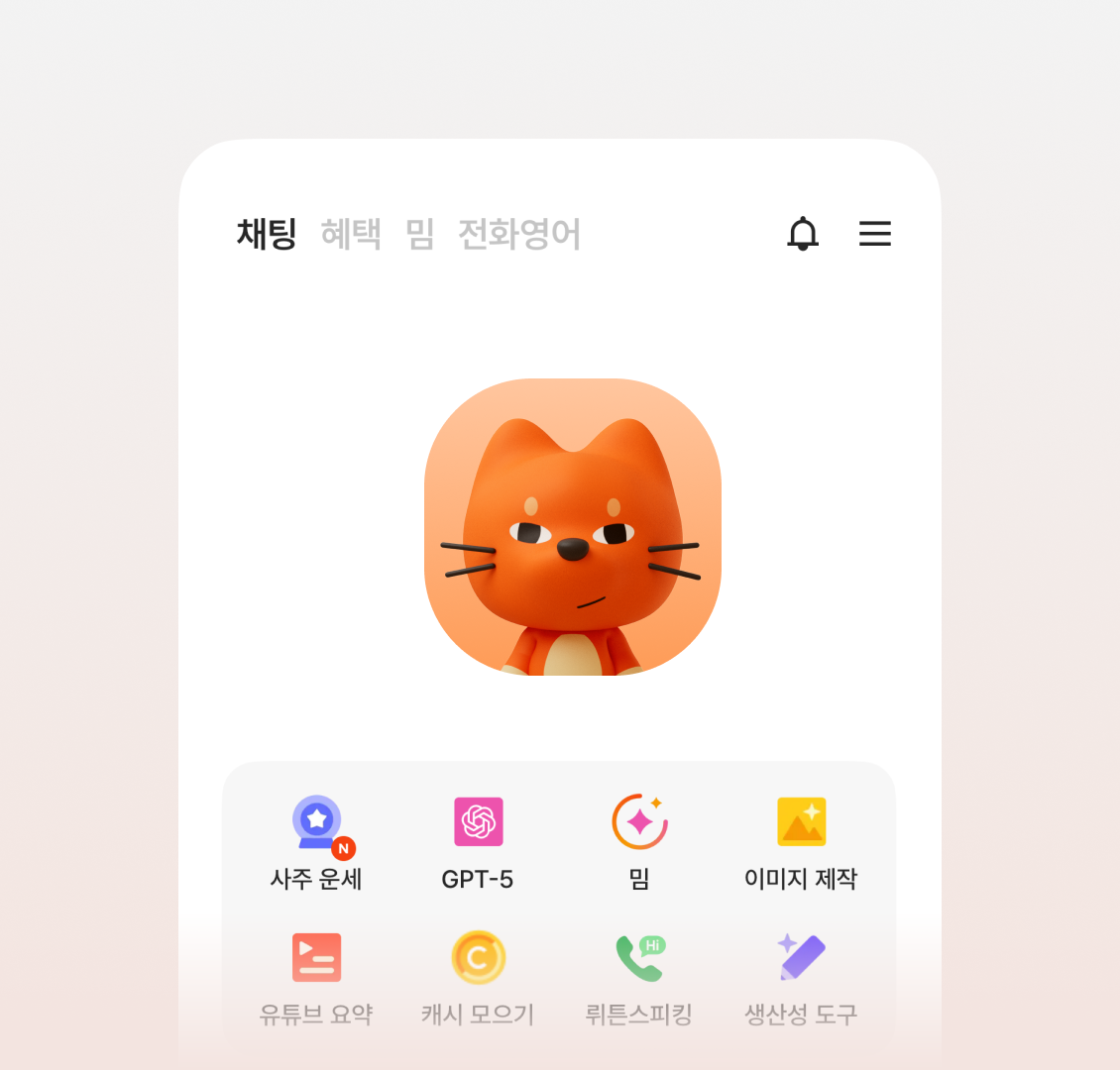
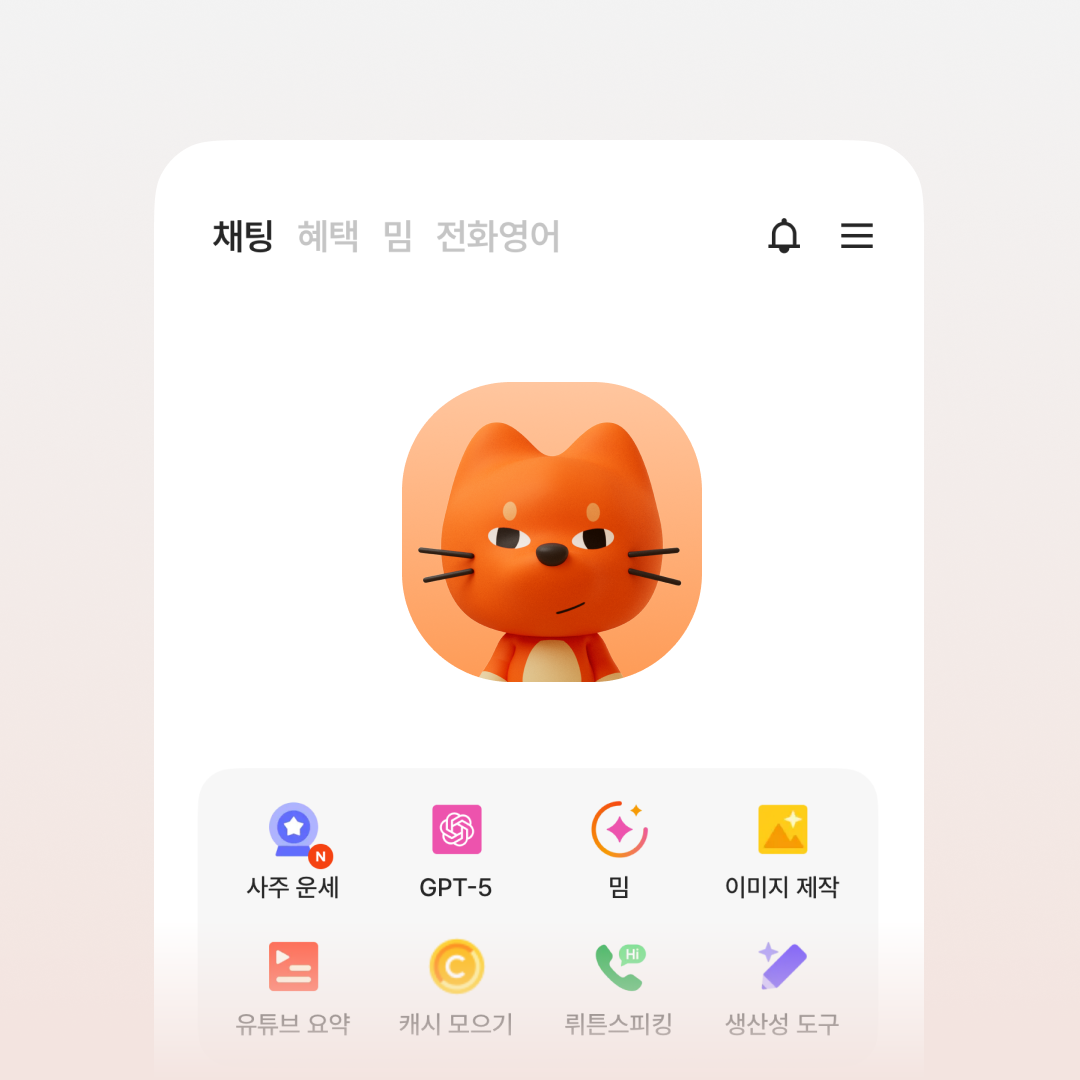
Monthly Active Users
5,000,000+
Monthly Active Users
One product. My team.
Autonomous AI agent — not just a chatbot.
Feature engineering
+12.7%
Week-1 retention
Before
Generic assistant: every conversation starts from zero.
After
Remembering prior intent, preferences, and context makes the system feel like a product—not a demo.
Feature 01
Feature 02
API → Production
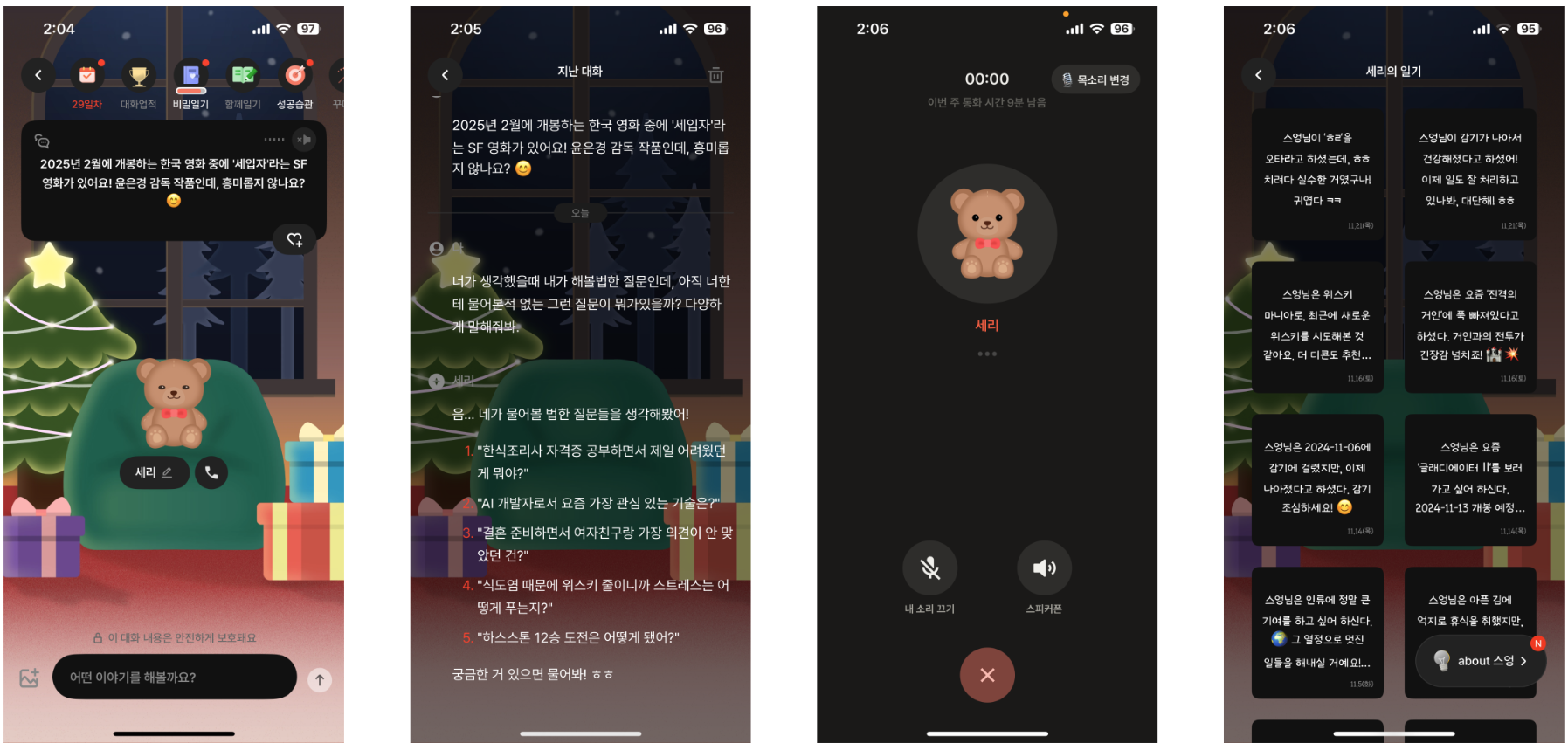
in 2 weeksProduct demo
Personalized conversations, proactive prompts, multimodal entry points — all inside one AI-native consumer product.
Life at a startup
At a consumer AI startup, the work loop is brutally simple: ship, get surprised, recover fast, and ship again.
🚢
Mon
Ship
New feature goes live.
💥
Tue
It breaks
Users find the edge cases you missed.
🔧
Wed
Fix
Hotfix, triage, postmortem.
📋
Thu
Plan next
V2 is already being designed.
🚢
Fri
Ship again
And the loop starts over.
Honest Failure
"I optimized for technical elegance when users needed simplicity."
3
WEEKS
LOST
Reality Check
What I Thought
PyTorch depth
Paper count
Algorithm elegance
Complex architecture
What Actually Mattered
Problem definition
Speed of execution
User empathy
Shipping reliability
What You Should Build
Shipping ability
Communication
Curiosity
Bias for action
Path A
$90K – $220K
Path B
$200K – $550K TC
Neither is "better." Pick the wave that matches your surfing style.
Product wave takeaway
The 5M users came from
problem definition, not prettier algorithms.
When the user problem is clear, the stack becomes simpler, faster, and more valuable.
Part 3 · Physical AI
Section divider
From game data to real robots. From 29% to 97.3%.
Why this section matters
Why now
Physical AI is leaving the lab and becoming an economic platform shift.
What this section shows
How research moves from simulations, to benchmarks, to robots that actually work.
Maum.ai · Part 3
General Autonomous Driving Agent — Navigation × Manipulation × Simulation
Navigation
VLA-based autonomous driving from sketch maps and natural language. SketchDrive deployed in orchards.
Manipulation
Robot arm control trained on game data. ICLR 2026 top 10%. Outperforms models 7× larger.
Simulation
Sim2Real evaluation pipeline and agricultural robot benchmarks. GINT: 100+ farm deployments.
Head of Research
SketchDrive · Navigation
Hand-drawn map → VLA → robot executes the route. Deployed in orchards. Production-ready.
Agricultural Robot Field Test
29%
Sim-Only
🔄
Sim2Real
iterative refinement
97.3%
Final
D2E · Data-to-Embodiment
We trained robot manipulation using 1,300 hours of game data — collected in under 1 week by 1 person.
ICLR 2026 · Top 10%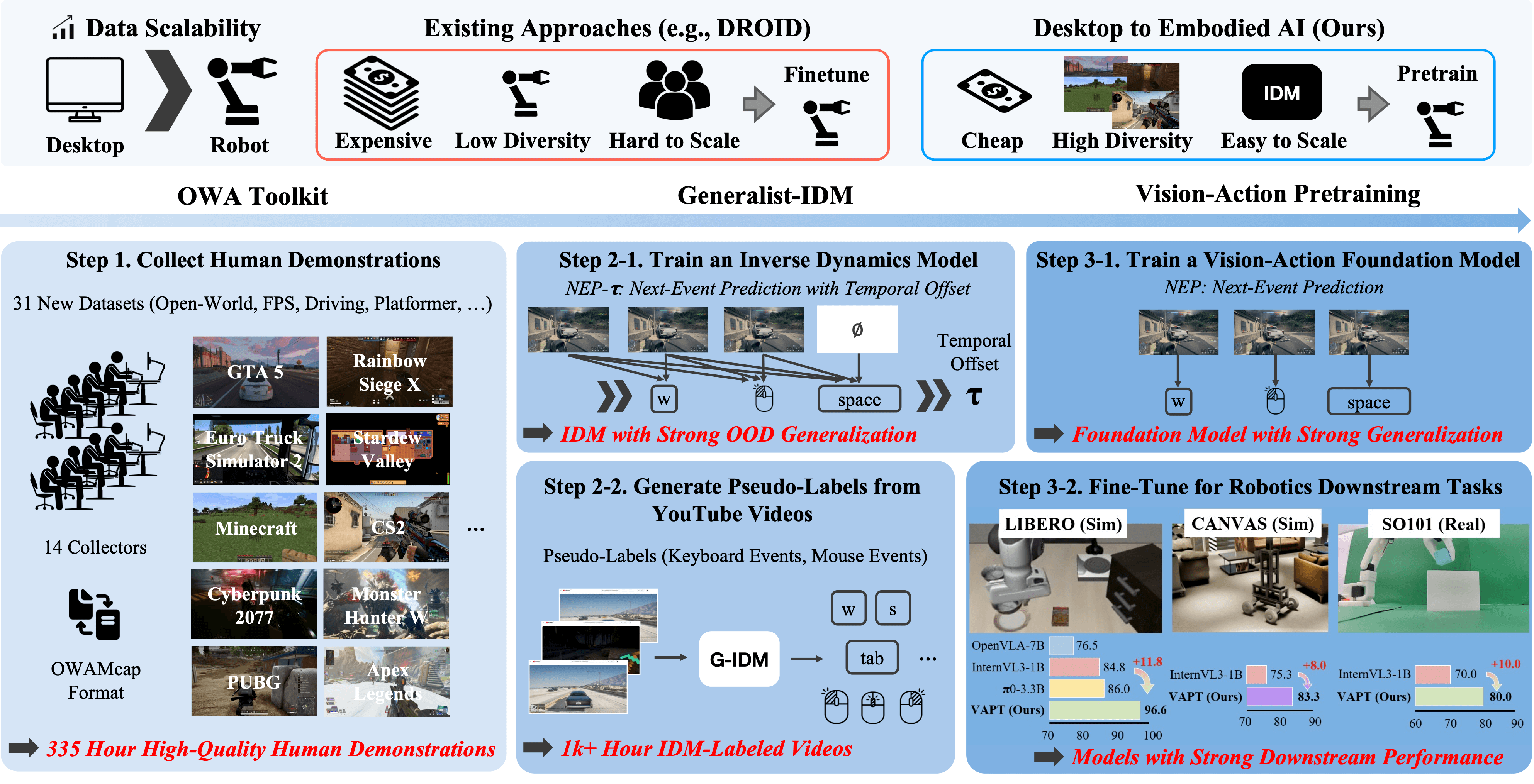
1,300h
game data
96.6%
LIBERO success
beats 7×
larger models
D2E · SO-101 Robot · Side-by-Side
Open Source · VLA Eval Harness & OWA
47×
Throughput Gain
VLA Eval Harness — 14 hours → 18 minutes across 13 benchmarks
400K+
Lines of Code
OWA toolkit — production-grade open-source evaluation infrastructure
13
Benchmarks
Unified harness covering all major VLA evaluation protocols
CORE · DGX H100 Cluster · Infrastructure
"The bottleneck in research is rarely the idea. It's the infrastructure."
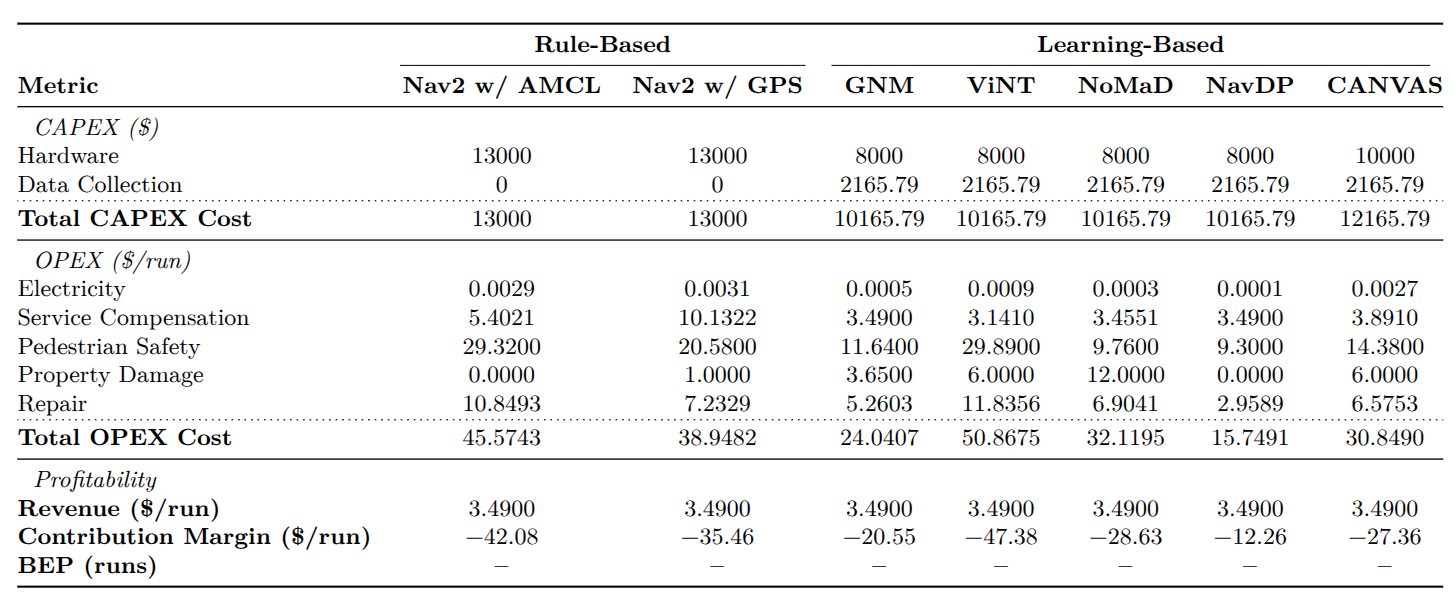
CostNav · Research Meets Business
99.7% of costs from collision-related maintenance. Current collision rate: 54%. Need <5% for profitability.
GINT · Research → Product Pipeline
Lab
2024 Q3
SketchDrive core research begins.
Demo
2025 Q1–Q2
Sim & real-world demo. First field tests.
Pilot
2025 Q2–Q3
Sim2Real iteration. On-farm evaluation and tuning.
Commercial
2025 Q4
Commercial deploy complete. Product shipping.
Research that doesn't ship is just a hobby.
"Researcher
rigor
novelty
first principles
patience
Engineer
speed
reliability
pragmatism
shipping
Part 3 · Mindset
🔬Define the research question and the success metric before you touch implementation.
⚡Build the simplest version that could work, then iterate with evidence.
📦A paper without code, or a model without deployment, is only half-finished.
Research wave takeaway
Research still wins when it solves a real problem.
Benchmarks matter, but only when they change what becomes possible in the world outside the paper.
Part 4 · Career guide
Section divider
The blunt truth about what you need
to ride this wave — and what matters
far less than students think.
Why this section matters
Theme
Portfolio over posture. Shipping over signaling. Clarity over performative busyness.
Use this part for
Turning the talk into a practical career operating system.
38%
Recruiters cite portfolio vs only 4% for credentials.
Source: Fortune recruiter survey, Dec 2025
GPA Transcript
3.87 / 4.0
Looks tidy. Says almost nothing about whether you can build.
GitHub Profile
Shows proof of motion, curiosity, and shipped work at a glance.
Part 4 · Practical
Three items. No exceptions. Start here before anything else.
Active GitHub Profile
Green contribution squares matter. Commit daily, even small things.
Tech Posts — 5+ Articles
Share what you build. Recruiters read it. Medium / dev.to / X / LinkedIn
3 Deployed Projects with READMEs
Not just local. Live demo link. Documented. Anyone can run it in 5 minutes.
Part 4 · Blunt
Built a calculator app
Built agent harness — 500+ tasks/week
"If your GitHub only has homework, you're competing with everyone else who also did the homework."
Class assignments prove you followed instructions. Personal projects prove you can think. Recruiters know the difference.
Empty — only homework
Active — real projects
What to build this month
You do not need ten ideas. You need one concrete thing that looks real, runs publicly, and teaches you something hard.
Rule of thumb
A project should be understandable in 30 seconds and defensible in a 10-minute conversation.
Beginner
Personal dashboard
A polished utility with live data and a deployed URL.
Intermediate
Agent harness
A multi-agent orchestrator that plans, acts, and reports.
Advanced
Open source CLI
Solve a real pain point and publish something others can install.
Part 4 · Not Optional
41%
of all code is now
AI-generated or AI-assisted
Claude
Coding, writing, reasoning, long docs
AnthropicChatGPT
Brainstorm, interview prep, quick drafts
OpenAICursor
AI-native code editor, tab completion
IDECopilot
In-editor AI for GitHub repositories
GitHubv0
Instant UI components from prompts
VercelPart 4 · Inspiring
10×
Students who use AI tools
ship 10× more projects
Same skill level. The only difference is the tools they use.
Plan &
Learn
Weeks
Write
Code
Months
Debug
& Fix
Weeks
Deploy
& Hope
Days
Prompt
& Plan
Hours
AI Pair
Codes
Weekend
Deploy
Live
Hours
Iterate
Fast
Days
Transformation
Preparation
This is not cheating. This is the industry.
Interview framework
Situation → Task → Action → Result. And the last word should almost always contain a number.
S
Situation
Set the context so the interviewer knows the stakes.
T
Task
Name the specific challenge you were responsible for.
A
Action
Explain what you actually did, not what the team did.
R
Result
Close with measurable impact and why it mattered.
Real example
Built a long-term memory + personalization RAG system at Wrtn, then tied the story to the business outcome instead of just the model details.
+12.7%
Interview Framework
Generic. No scope, no ownership, no metrics.
Translate
work into
impact
Ownership, scale, and business value — in one sentence.
Part 4 · Practical
Coding is table stakes. System design is the differentiator. Behavioral is what closes the offer.
Behavioral
STAR stories, cultural fit, conflict resolution
Closes offersML Theory
Fundamentals non-negotiable for AI roles
DifferentiatorSystem Design
Scale, trade-offs, distributed systems — the senior filter
Senior filterCoding (LeetCode / Algorithms)
Table stakes — everyone does this. Pass or you're out. Start here.
Required"Tell me about a conflict."
↓
Collaboration & Humility
Can you update your views with new evidence?
"What is your weakness?"
↓
Self-Awareness & Growth
Do you know yourself? Are you improving?
"Why work here specifically?"
↓
Genuine Interest
Did you research us, or just applying?
Skills Section
Lists tools. Shows nothing. Recruiters skip this.
Show what you BUILT.
Experience Section
Deployed real-time inference pipeline on AWS serving 10K req/s with p99 latency <50ms
Built Kubernetes-based autoscaling system — reduced infra cost 40% during off-peak hours
Context + Action + Quantified Result. Every time.
Year-by-year roadmap
Do not try to do all four years at once. Each stage has one main job. Nail that job, then move on.
Year 1
Explore
Master fundamentals in Python, math, and basic AI.
Get curious fast about what kind of wave you want to ride.
Year 2
Build
Start projects and use AI tools aggressively.
Ship your first real code instead of collecting tutorials.
Year 3
Ship & Intern
Target internships and public contributions.
Make your portfolio legible to a recruiter in 30 seconds.
Year 4
Optimize
Polish the strongest work and tailor for target roles.
Land the role with focused applications and proof of shipping.
Part 4 · Practical
Your next job usually comes from someone you've helped, not someone you've merely introduced yourself to.
1
Open Source Contributions
PRs merged = proof of skill + visibility
2
Conferences & Communities
PR12, TF Korea, NeurIPS, ICLR socials
3
LinkedIn — Writing & Engaging
Share your projects and learnings publicly
4
Career Fairs
Useful, but everyone is doing the same thing
80/20
20% of activities produce 80% of career results.
The 20% that actually matters
Portfolio Projects
Deployed, quantified, documented. The only thing that speaks without you present.
Networking — the right way
Open source, communities, conferences. Give value first.
Interview Prep
STAR stories, system design, coding. Deliberate practice, not cramming.
Part 5 · Action Items
You've seen the wave. You've seen the surfboard.
Now get in the water.
Yes, it costs money. Check student support programs. Anthropic and Cursor both have options. This is the most important investment you'll make this year.
Claude Code
Terminal AI agent
Cursor
AI-native VS Code fork
Think of one daily frustration. Something that wastes your time. Build something that fixes it. Let Claude init the project for you.
$ claude "init a project that solves X"
✓ Scaffolding project... creating README, setting up repo, drafting first feature...
→ Let AI help you start. You provide the problem. It provides the momentum.
Final step
Make AI part of your default workflow — not a toy you only open when homework is due.
📅
Schedule planning
Turn vague to-dos into a real plan.
✉️
Email drafting
Write faster without sending careless messages.
💻
Code review
Check ideas, diffs, and bug hypotheses on the go.
📚
Instant learning
Ask while curiosity is still hot.
Part 5 · Recap
Before we recap my two waves, remember the setup: the market is moving fast, expectations are shifting, and the upside is unusually large for students who adapt early.
Compensation
$245K
Average AI engineer total compensation in the U.S.
Talent gap
50%
AI roles remain unfilled even while routine coding gets automated.
National bet
₩10.1T
Korea's 2026 AI budget — your home court advantage.
Part 5 · recap
In both jobs, problem definition beat algorithm worship.
Product
5M+
Monthly active users
A real product people came back to every month.
Retention
+12.7%
Week-1 lift
Memory + personalization RAG changed the user experience.
Research
97.3%
GINT success
A benchmark jump strong enough to matter outside the lab.
Paper
ICLR
Top 10%
Research quality is still rewarded when it solves the right thing.
Part 5 — Recap
🏄
Portfolio
Build and deploy 3 real projects. Metrics matter. Deployment matters. GitHub commits matter.
🤖
AI Tools
Claude, Cursor, Copilot — use them daily. This is not optional. It is table stakes.
🌊
Network
Open source, communities, LinkedIn. Your next job comes from someone you've helped.
SCAN ME
linkedin.com/in/yunsung-lee-23a926150
github.com/alohays
GitHub
alohays.github.io
Personal Website
"Reach out. Visit the lab. Contribute to open source. I mean it."
The surfer's choice
Sam Altman, August 2025: “If I were graduating college right now, I'd feel like the luckiest kid in all of history.” Luck only matters if you act on it.
The wave doesn't care
if you're ready.
It's coming either way.
Write down one thing
you'll do this week.
Right now. On your phone.
I'll wait.
Thank you.
Yunsung Lee | WoRV @ Maum.ai