
Allagma / for researchers using coding agents
Have your coding agent carry out a study.
Supply a question, source materials and resource limits. Your agent plans the study, writes and runs the code, analyzes the results, and drafts a report.
Receive the figures and report with the code, data and attempt history needed to check them.
Offline example: Python 3.11+, Git, no model account.
How you work with the agent
You set the question. The agent develops the study.
- 01 / YOU SUPPLY
Question and materials
Write a brief, provide the sources, and set time and compute limits.
- 02 / THE AGENT PLANS
Protocol and code
Choose comparisons, check feasibility, and fix the plan before confirmation runs.
- 03 / THE AGENT RUNS
Experiments and analysis
Execute the work, recover from failures, and examine the results.
- 04 / YOU REVIEW
Figures and report
Read the findings and critique, inspect the code and data, and reproduce the analysis.
Completed native-agent study / weight EMA / r07
When does averaging model weights help?
The agent trained tiny diffusion models to compare weight averaging across training durations and learning-rate schedules. The completed package includes the protocol, code, saved weights, statistical analysis, figures, report and critique.
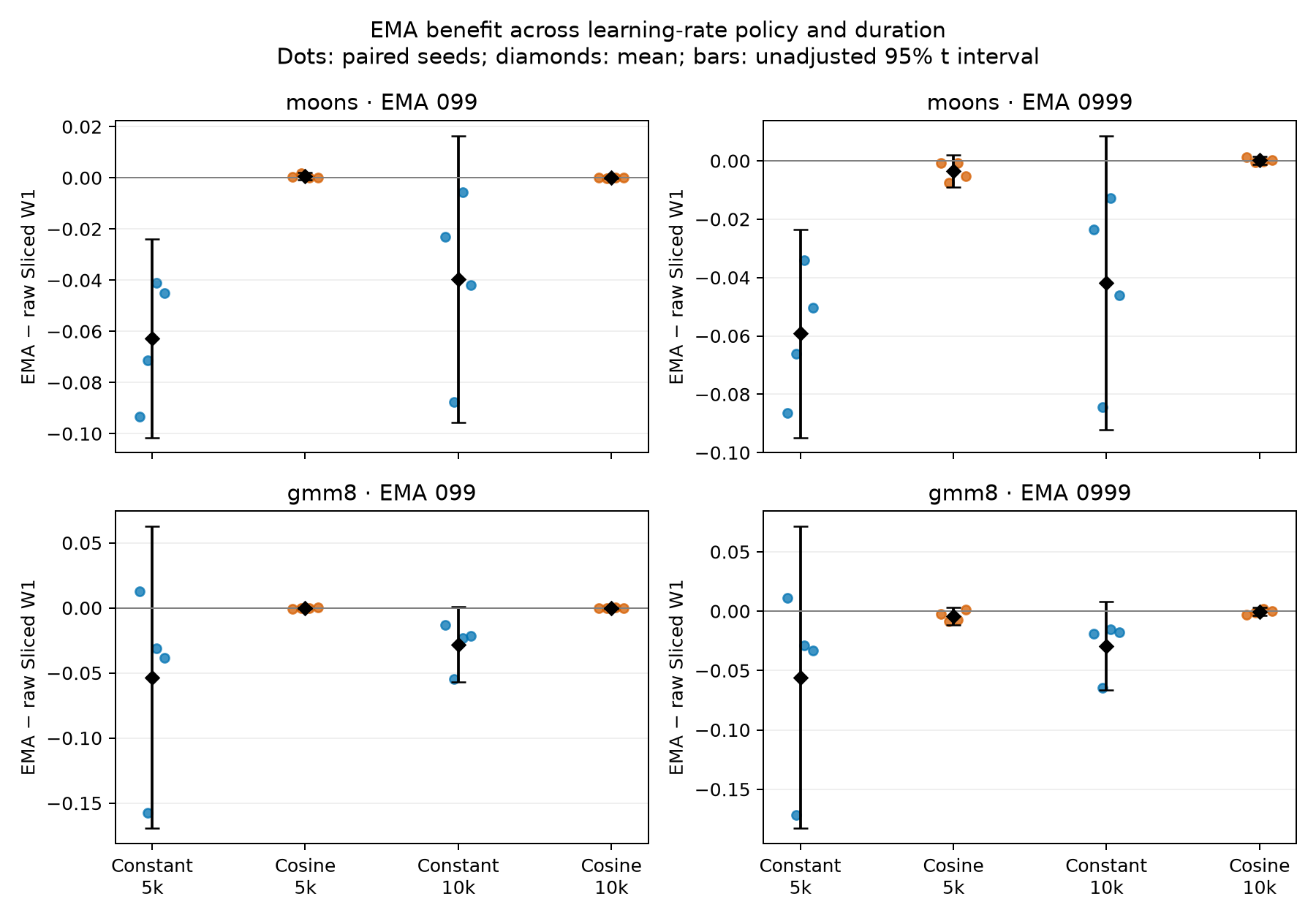
From the agent's report / report-r1
The observed relative benefit of EMA depends on the full schedule policy. At both durations and on both datasets, mean EMA-minus-raw differences favor EMA more strongly under constant learning rate than at completed cosine endpoints.
With four seeds per dataset, the duration and interaction estimates remain inconclusive. A smaller relative benefit under cosine scheduling does not imply worse absolute EMA quality.
Read the result and its limitsDownload the agent's full report (Markdown)
This is a retained study, with raw-data and checkpoint verification. A second full training replay is not claimed. Links within the downloaded report resolve in the full restored package. AI Scientist source attribution and license apply to the adapted study materials.
What Allagma adds
Enough context to check the work later.
Allagma gives the agent reusable methods for planning, execution, analysis and critique. It keeps the agreed protocol, failed attempts and the data behind each claim with the report. You can see which runs informed a finding and recompute the reported numbers.
The researcher chooses the question and judges whether the methods and conclusions make sense. A successful audit checks the recorded work; it does not replace scientific review.
How the research record fits togetherWork on your own question
Prepare a study from a brief, source materials and a finite resource profile, then explicitly start a native Codex session. Preparation is offline; the session uses your account's model allowance.
Prepare a native studyThe supervised runner is qualified on the recorded macOS/Codex setup. Completion depends on the task and budget; an additional onboarding probe exhausted its session limits before packaging. Read the setup and measured limits.
Start here / offline toy study
Try the whole process on a small example.
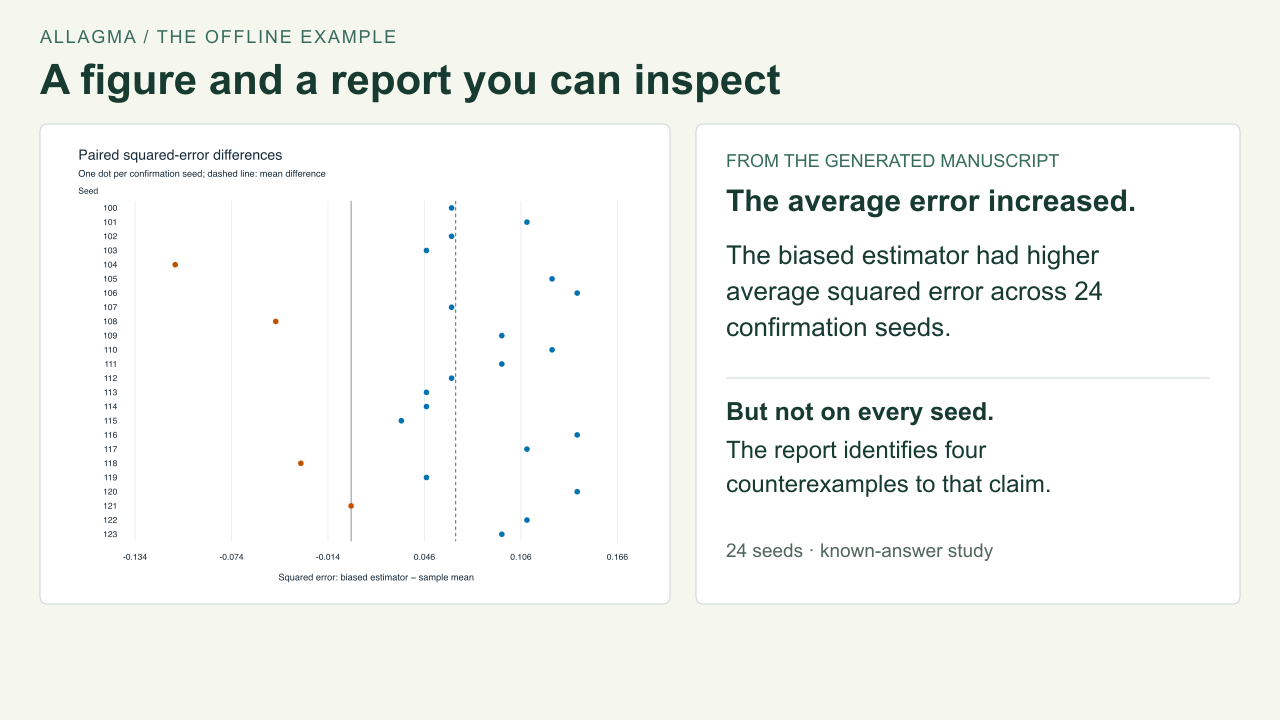
The introductory study asks whether adding a fixed bias increases a mean estimator's squared error. It supplies the scientific code, so you can generate a figure and report without a model account, GPU or package installation.
The example runs 24 confirmation seeds and retains an actual failure and interruption. It is a known-answer demonstration of the workflow.
Get the source and run itpython3 -m allagma toy \
--destination work/my-first-studyOpen the generated figure, manuscript and claim ledger. Recompute the result from the retained data.
Preview the example's outputsOther completed native-agent studies
Read the question, result and qualifications.
A graph-classification paper reproduced
All six requested answers match the original scorer. Inspection also found that two datasets printed the wrong predictor labels. The report preserves and explains that defect.
GENERALIZATION / MODULAR ADDITION r04Better held-out accuracy, without observed grokking
Weight decay improved final accuracy in four paired seeds. No trajectory reached the prespecified sustained 95% threshold, so the study does not claim a grokking transition.
These are completed examples selected by frozen run order. The twelve-session comparison reports all runs and its limits; it does not establish general research superiority or consistent cost savings.
Allagma 0.3.0rc2 · Source release candidate · Host support · MIT core and study-specific licenses